
Table of Contents
ToggleAVIA Ceramic Window Tint Installation in Round Rock, TX
Atomic Auto Spa installs AVIA ARMOR ceramic window film in Round Rock. AVIA is headquartered three miles from our shop at 208 Commerce Blvd, making us a rare Central Texas installer using locally made professional film. The full AVIA lineup: CARBON, IR CERAMIC, CERAMIC IR PLUS.
Send us A Message
Why Ceramic Film Beats Dyed and Metallic Tint
Most window tint sold in Texas falls into three product categories: dyed, metallic, and ceramic. Each performs very differently in Round Rock summer conditions. If you’re comparing all the window tint options we install, our main tint page covers the complete lineup. This page focuses specifically on why ceramic is worth the investment.
Dyed film is the cheapest option. It blocks light but does almost nothing for heat. The dye also fades, turning purple after a few summers. Your car gets no cooler, and the film looks worse every year.
Metallic film rejects more heat but interferes with cell signals, GPS, and radar detectors. The metallic layer acts like a Faraday cage around your phone. Texas drivers who need reliable signal for navigation and calls find this out quickly. Read our full ceramic vs metallic tint breakdown for a side-by-side comparison.
Ceramic film contains no metal or dye. Instead, ceramic nanoparticles are embedded in the film to block infrared heat while allowing visible light through. The result: significant heat rejection without signal interference, fading, or darkening the film beyond what Texas law allows.
Ceramic vs Dyed vs Metallic Tint: Quick Comparison
Feature | Dyed Film | Metallic Film | Ceramic Film (AVIA) |
|---|---|---|---|
Heat rejection | Minimal | Good | Excellent |
Signal interference | None | Blocks cell/GPS/toll tag | None |
Color stability | Fades to purple in 3-5 years | Stable | Stable |
UV blocking | Some | Good | 99% or higher |
Warranty length | 3-5 years typical | 5-7 years typical | Lifetime (original owner) |
Cost tier | Entry | Mid | Higher (worth it in TX) |
For Central Texas drivers dealing with 100+ degree summers, ceramic film is the only tint category that meaningfully reduces cabin heat load without introducing signal problems.
AVIA’s ceramic line uses this technology across all three product tiers.
The AVIA Film We Install
AVIA ARMOR is a Round Rock-based film manufacturer. They’re headquartered at 208 Commerce Blvd and distribute professional films to installers across the country. Being local to them matters to us; our customers get faster access to warranty support, technical documentation, and product updates than customers of out-of-state suppliers do.
The AVIA ARMOR automotive window film line includes three tiers:
AVIA CARBON. The entry point into real ceramic technology. Uses carbon and ceramic technology for solid heat rejection and UV blocking. A major upgrade over dyed film at an accessible price point. For daily drivers who want significant improvement without the higher price of a flagship ceramic. If cost is the deciding factor, see our detailed cost comparison between ceramic and regular tint.
AVIA IR CERAMIC. Mid-tier film with superior infrared blocking. Infrared radiation is the specific wavelength that makes your car feel hot inside. IR CERAMIC targets that wavelength specifically, rejecting the heat you actually feel while preserving the clarity you need through your windows.
AVIA CERAMIC IR PLUS. The flagship ceramic film with maximum heat rejection performance. For Central Texas summers, owners of performance vehicles, and customers who want the best AVIA make. This is the film we put on Tesla Model S owners, BMW M series protection, and Porsche customers who park outside.
All three tiers carry a lifetime manufacturer’s warranty for the original owner. All three meet Texas tint law requirements at the correct VLT. And all three are professionally cut and installed by our certified technicians.
Texas Tint Law: What's Actually Legal
Texas tint law is where most customers get confused. Here’s what matters in 2026.
- Front side windows: 25% VLT minimum. Your side windows must allow at least 25% of visible light to pass when measured together with the factory glass. This is the most strictly enforced rule. Officers carry portable meters. Anything darker than 25% is a ticket and a failed state inspection.
- Windshield: No tint below the AS-1 line. A tint strip is allowed on the top 5 inches or above the AS-1 line, whichever is closer to the top. The strip cannot be red, amber, or blue. Clear ceramic film for UV and heat protection is allowed on the full windshield if it doesn’t affect visible light transmission.
- Back side windows: Any darkness. You can go as dark as you want, including 5% “limo tint.”
- Rear window: Any darkness, as long as your vehicle has dual outside mirrors that give a view of at least 200 feet behind the vehicle. Without dual mirrors, the rear window reverts to the 25% VLT requirement.
- Reflectivity: Maximum 25% on all windows. Metallic films often exceed this cap.
- Compliance sticker: A label must be placed on the driver ‘s-side window, in the rearmost bottom corner, identifying the tint as compliant.
We measure every window with a meter before and after installation. We install the legal film, label it correctly, and provide you with documentation you can keep in your vehicle. If your primary vehicle needs to pass inspection, we’ll never install something that won’t.
Our Installation Process
Tint quality is half the film and half the install. A poorly installed high-end film leaves bubbles, lifted edges, and contamination between the glass and the film. We’ve seen customers bring us cars with AVIA or similar quality films that look terrible because the install cut corners.
Here’s how we do it.
Vehicle prep. Windows get cleaned with deionized water filtered under 10 PPM, the same water standard we use for professional paint correction prep. The rubber gaskets around each window get cleaned and isolated to prevent contamination during installation. Interior door panels get covered to protect upholstery.
Pattern cutting. We use computer-cut patterns for every window. Hand-cutting on the glass introduces the risk of scoring factory glass or rear window defroster lines. Pre-cut patterns eliminate that risk entirely.
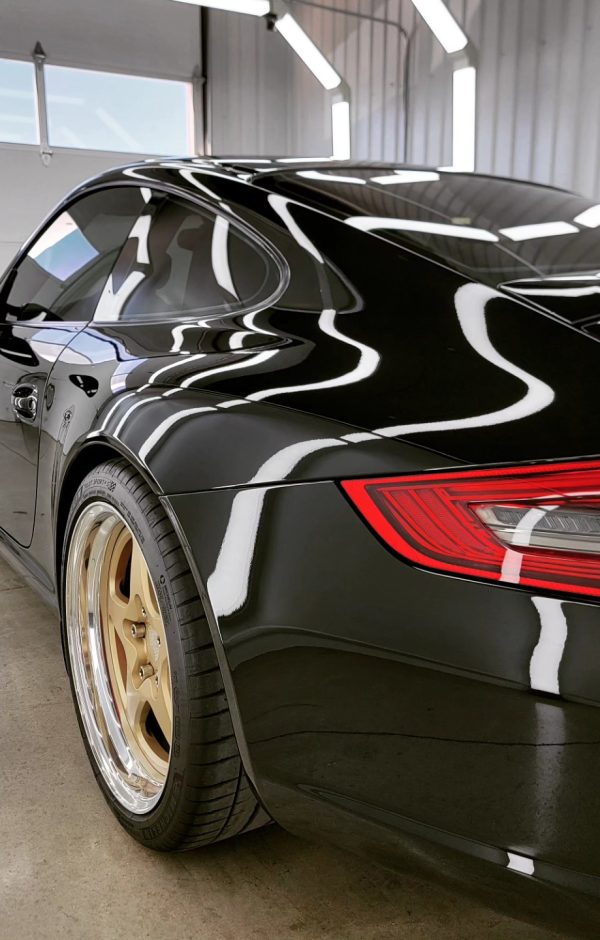
Application. Filming takes place in our climate-controlled facility, the same environment we use for our ceramic coating installations. Temperature and humidity during installation affect how the film adheres. Shops that install tint in open bays or in hot weather get inconsistent results. We control the environment.
Inspection. Every window is reviewed under high-intensity lighting after installation. We check edges, corners, contamination, and defroster line alignment on rear windows. Any issue gets addressed before the vehicle leaves.
Cure time. Ceramic film needs three to seven days to fully cure. Don’t roll windows down for the first few days, and avoid washing windows for at least a week. We’ll walk you through aftercare before you pick up the car.
Ceramic Tint for Tesla and EVs
EV and hybrid owners get the most obvious benefit from ceramic tint. Your car’s battery works less hard maintaining cabin temperature when the sun load is reduced. That translates directly to range.
For Tesla protection customers, we typically pair AVIA CERAMIC IR PLUS on the glass with GYEON ceramic coating on the paint. The combination manages heat load from both the radiant sun and surface temperature, keeping the vehicle cooler inside and on the paint.
For our Cybertruck owner packages, the ceramic window tint pairs with STEK PPF on the stainless. Same principle, different protection at the exterior.
Ceramic Tint for Performance Vehicles
Owners of Porsche protection packages generally choose CERAMIC IR PLUS. Mercedes-Benz and BMW owners go the same route. The film pairs naturally with our paint protection services.
We also work with owners who need exotic vehicle protection. For Ferrari, Lamborghini, McLaren, and other high-value vehicles, tint integrates into the full protection package alongside PPF and ceramic coating on the exterior.
Pairing Window Tint With Paint Protection
We install ceramic window tint as a standalone service or as part of a multi-service package. Most customers who come in for paint protection film or GYEON ceramic coating application add AVIA tint to the same appointment. The efficiency of scheduling everything at once saves you a separate visit.
For customers interested in combining multiple protection services, our STEK paint protection plans include options for bundling window tint.
External Resource
For AVIA’s complete technical documentation, warranty registration, and product specifications, the manufacturer site is available at AVIA ARMOR. As a Round Rock company, they’re a real asset to our local protection industry.
Serving Round Rock and Central Texas
We’re at 3401 Sunrise Rd Suite 210 in Round Rock. Open Monday through Friday, 9:30 AM to 6:00 PM.
Customers come to us from Austin and Cedar Park regularly.
We also serve Georgetown and Pflugerville and surrounding Central Texas communities.
Call (512) 888-9310 or request a tint quote to discuss your vehicle.
Ceramic Window Tint FAQs
What ceramic window tint do you install?
We install AVIA ARMOR ceramic window film across all three tiers: CARBON (entry-level ceramic), IR CERAMIC (mid-tier with infrared blocking), and CERAMIC IR PLUS (flagship maximum heat rejection). AVIA is a Round Rock manufacturer headquartered three miles from our shop. All three tiers carry a lifetime manufacturer warranty for the original owner.
Is ceramic tint worth the extra cost over dyed film?
For Texas drivers, yes. Dyed film blocks light but does almost nothing for heat, and it fades to purple within a few summers. Ceramic film rejects significant heat using nanoparticle technology with no dye fade and no signal interference. The performance difference is noticeable on your first drive in Texas summer. Ceramic film also lasts 10 to 15 years where dyed film often fails in three to five.
What's the legal tint percentage in Texas?
Front side windows must allow at least 25% VLT, meaning at least 25% of visible light passes through the combined film and factory glass. Back side windows and the rear window can be any darkness if your vehicle has dual outside mirrors. The windshield can have a tint strip only above the AS-1 line or in the top five inches. Reflectivity is capped at 25% on all windows. Red, amber, and blue tint colors are prohibited.
Will ceramic tint interfere with my phone signal, GPS, or toll tag?
No. AVIA ceramic films contain no metallic particles, so they don’t block or interfere with cell signals, GPS, radar detectors, toll tags, or keyless entry systems. This is one of the primary advantages of ceramic over metallic tint films. Metallic tints on modern vehicles often cause significant issues with factory electronics.
Does ceramic tint actually make my car cooler?
Yes, measurably. Infrared radiation from the sun is what makes your cabin feel hot. AVIA IR CERAMIC and CERAMIC IR PLUS specifically target and block infrared wavelengths. The result is a significantly cooler interior in direct sun, reduced load on your air conditioning, and less heat fatigue on leather and plastic interior surfaces. For EV and hybrid owners, reduced AC load translates to measurable range improvement in summer. Many Mercedes-Benz protection customers add ceramic tint for exactly this reason with EQ models.
Can you tint my windshield?
We can install a tint strip on the top 5 inches above the AS-1 line, per Texas law. For UV and heat rejection across the full windshield, we can install a clear ceramic film that blocks UV and IR without affecting visible light. That’s legal and effective. Full windshield darkening below the AS-1 line is not legal in Texas without a medical exemption.
How long does ceramic tint installation take?
A standard sedan takes three to four hours for all windows. SUVs and larger vehicles take four to six hours depending on window count and complexity. We work in a climate-controlled indoor facility, which matters for film cure quality. We’ll give you an accurate timeline when you book.
What's the cure time after installation?
Ceramic film needs three to seven days to fully cure. During that time, avoid rolling the windows down and avoid washing windows. Some small streaks or water pockets under the film are normal during cure and will disappear as the film sets. We walk through aftercare with every customer.
Do you back the installation with a warranty?
AVIA provides a lifetime manufacturer warranty on the film for the original owner. We back our installation work on top of that. If there’s a bubble, lifted edge, or installation issue within the warranty period, we address it.
Can I get ceramic tint and paint protection in the same visit?
Yes. Many of our customers bundle AVIA ceramic tint with STEK paint protection film or GYEON ceramic coating. We coordinate scheduling so everything happens in the same service window rather than multiple appointments. Call (512) 888-9310 or book a consultation to plan a combination package.